Agricultural success is usually assessed by what can be seen above the ground.
Farmers examine crop colour, plant height, fruit size and yield.
Yet the condition that determines much of this performance lies beneath the surface.
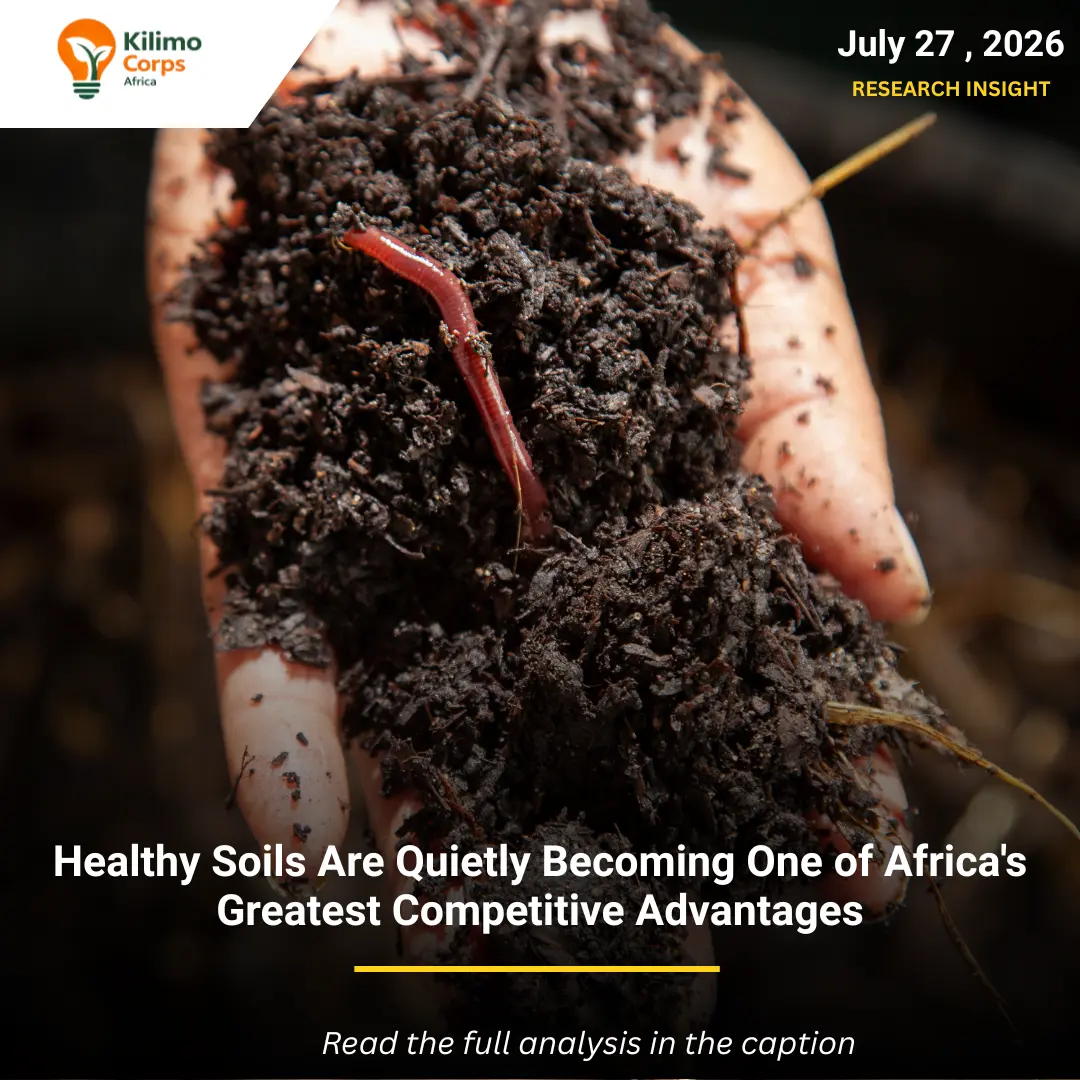
Soil is a living production asset.
When it loses organic matter, structure, nutrients and biological activity, yields become more expensive and difficult to sustain.
Africa’s soil challenge
The Food and Agriculture Organization reported in June 2026 that approximately 65 percent of productive land across Africa is affected by degradation linked to unsustainable practices, land pressure, poor management and climate change. FAO also noted that agriculture employs more than 60 percent of the population in sub-Saharan Africa, making soil health an economic as well as environmental concern.
A separate FAO assessment reported that around 40 percent of soils across Africa are degraded, especially through erosion, nutrient depletion, declining organic matter and biodiversity loss.
Globally, human-induced land degradation is affecting crop yields for an estimated 1.7 billion people living in areas where yields have fallen by at least 10 percent.
These figures show that soil degradation is not a distant threat. It is already affecting farm productivity, rural livelihoods and food security.
Soil is not an inert growing medium
Healthy soil stores water, cycles nutrients, supports beneficial organisms and anchors plant roots.
When soil structure deteriorates, rainfall is less likely to infiltrate and more likely to run off.
This increases erosion and reduces the amount of moisture available to crops.
Erosion removes fertile topsoil much faster than new soil can naturally form. FAO warns that erosion rates can exceed soil-formation rates, making severe losses effectively irreversible within a human lifetime.
The hidden cost of degraded soils
Degraded soils often require farmers to apply more fertiliser to maintain the same yield.
However, fertiliser alone cannot correct every soil problem.
If soil is compacted, acidic, saline, low in organic matter or biologically depleted, nutrients may not be used efficiently.
This leads to higher costs and disappointing results.
Soil testing should therefore guide fertiliser and amendment decisions.
Farmers need to know the pH, nutrient status, organic matter and other characteristics of their soils rather than relying solely on general recommendations.
Practices that rebuild soil health
There is no universal solution for every farm, but several practices can support soil restoration when applied appropriately:
- Crop rotation
- Cover cropping
- Compost and manure application
- Reduced soil disturbance
- Erosion-control structures
- Agroforestry
- Mulching
- Integrated nutrient management
- Controlled grazing
- Legume integration
- Responsible irrigation
- Soil testing
Soil health is a competitive issue
As climate variability increases, farms with better soil structure and organic matter are often more capable of retaining moisture and recovering from stress.
This makes soil health a strategic business advantage.
Agricultural enterprises that protect their soils may achieve more stable production, lower long-term input costs and better resilience.
Governments should therefore treat soil restoration as agricultural infrastructure.
Just as roads and irrigation support production, so does the productive capacity of the land itself.
Kilimo Corps Africa perspective
Africa’s future food security will depend on whether today’s production systems preserve the resource base required by tomorrow’s farmers.
Soil should not be treated as something farmers merely use. It is capital that must be maintained.
The strongest agricultural economies of the future will be those that produce competitively without destroying the foundation of production.
References
- Food and Agriculture Organization of the United Nations. Soil Health and Fertilizer: Policy and Investment Prospects in Sub-Saharan Africa, June 2026
- Food and Agriculture Organization of the United Nations. Restoring Southern Africa’s Soils, March 2025
- Food and Agriculture Organization of the United Nations. The State of Food and Agriculture 2025
- FAO Global Soil Partnership. Soil Erosion, Drivers and Impacts