Calls for young people to join agriculture are now common across Africa.
They appear in government speeches, university programmes, development projects and youth conferences.
Yet the invitation is often incomplete.
Young people are frequently encouraged to participate in farming as producers or labourers, but rarely prepared to become founders, executives, investors, processors, exporters and technology builders.
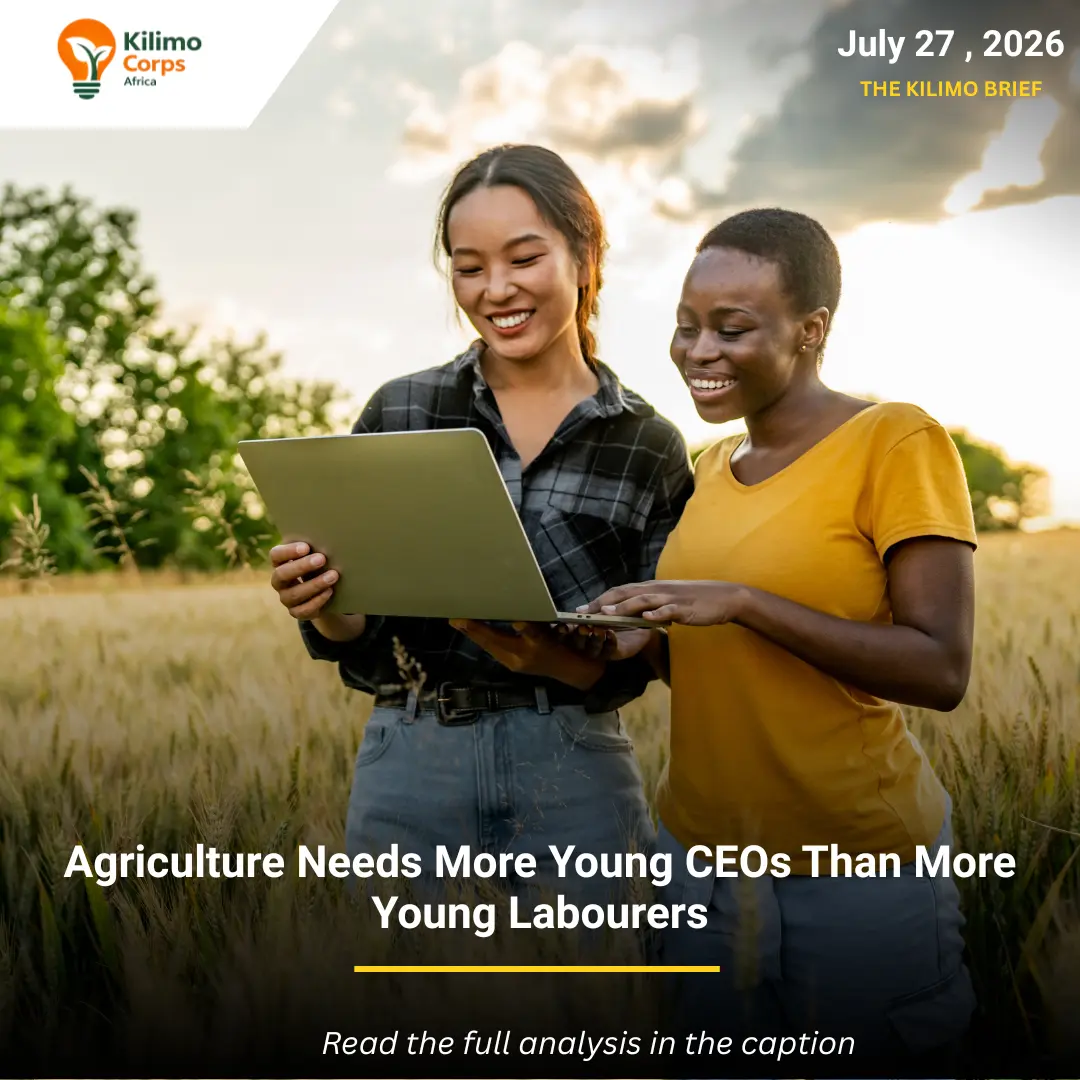
Africa does not only need more young people working in agriculture. It needs more young people owning and leading agricultural enterprises.
Beyond participation
Agriculture is not a single occupation.
It is a vast economic system that includes seed companies, logistics providers, equipment manufacturers, food processors, laboratories, financial institutions, software platforms, wholesalers, exporters and retailers.
Young people should be prepared to lead businesses throughout this system.
The International Labour Organization and IFAD have emphasised that investments in skills, finance, modern technology and market integration can create entrepreneurship, decent employment and green and digital jobs for rural youth.
The African Union–ILO Youth Employment Strategy for Africa similarly calls for young people to become drivers of resilient and diverse economies rather than remaining only jobseekers.
Why ownership matters
A young employee may improve one part of a value chain.
A young enterprise builder can create jobs, introduce technology, expand markets and attract investment.
This does not mean every young person must register a company. It means agricultural policy and education should provide credible pathways into leadership, ownership and enterprise creation.
Young agripreneurs need more than motivational speeches. They need access to:
- Practical business education
- Affordable finance
- Mentorship
- Incubation support
- Market contracts
- Technology
- Professional networks
- Research and product-development support
- Clear and affordable licensing systems
Agricultural education must evolve
Many agricultural graduates understand production but remain underprepared for commercial leadership.
Curricula should include accounting, sales, procurement, digital marketing, contract negotiation, intellectual property, human-resource management and investment readiness.
Agriculture students should graduate able to prepare a business model, analyse a market, lead a team and communicate with investors.
Technical competence remains essential. But technical competence without commercial capability limits the scale of impact.
The CEO mindset
Being a CEO is not about the title. It is about taking responsibility for creating value.
A CEO thinks about customers, systems, people, risk, quality and growth.
A farmer with two acres can apply this mindset. So can a cooperative leader, food processor, input distributor or agricultural trainer.
The objective is to move from survival-oriented activity to structured enterprise.
Institutions must create pathways
Governments, universities, financial institutions and development partners should measure youth-agriculture programmes by more than participant numbers.
They should track:
- Enterprises created
- Jobs generated
- Revenue growth
- Market contracts secured
- Products launched
- Business survival rates
- Investment raised
- Technologies adopted
Kilimo Corps Africa perspective
Africa’s agricultural transformation will require a generation that sees farming as one part of a much larger enterprise economy.
We must prepare young people to become producers, but also processors, innovators, exporters, financiers, educators and employers.
Agriculture needs hands. But it also needs founders, executives and institution builders.
References
- International Labour Organization. Why Invest in Rural Youth and Jobs in Agriculture in Africa?
- International Labour Organization and IFAD. ProAgro YOUTH Programme
- African Union and International Labour Organization. Youth Employment Strategy for Africa
- Kilimo Corps Africa. Editorial analysis, July 2026