Introduction
Every planting season begins with hope.
Farmers prepare their land, invest in seed, purchase fertilizer, organise labour and wait for the first rains with optimism that months of hard work will translate into a successful harvest.
Yet increasingly, one of the greatest threats to agricultural productivity is not drought, pests or fluctuating market prices.
It is counterfeit agricultural inputs.
A recent multi-agency enforcement operation in Uasin Gishu County, where authorities arrested suspects and seized thousands of bags of suspected counterfeit fertilizer, has once again brought national attention to an issue that quietly affects thousands of farmers across Africa.
While law enforcement agencies continue their investigations, the incident highlights a broader challenge that extends beyond one county or one country.
Counterfeit fertilizer threatens food security, farmer incomes, soil health and public confidence in agricultural markets.
For farmers, the question is no longer whether counterfeit products exist.
The more important question is: How can I ensure the fertilizer I purchase is genuine?
The answer begins with understanding how counterfeit fertilizer enters the market and what practical steps every farmer can take to protect both their investment and their harvest.
Why Counterfeit Fertilizer Is Becoming a Serious Agricultural Threat
Agriculture depends on trust.
Farmers trust that certified seed will germinate. Consumers trust that food is safe. Buyers trust that produce meets quality standards.
Similarly, farmers trust that the fertilizer they purchase contains the nutrients indicated on the packaging.
When that trust is broken, the consequences extend far beyond one individual farm.
Counterfeit fertilizer can contain little or none of the nutrients required for healthy crop growth.
Some products are diluted with sand, soil or other inert materials. Others are repackaged expired products or genuine fertilizer sold under misleading labels.
In more serious cases, counterfeit products may contain substances capable of damaging crops or degrading soil quality.
Unlike counterfeit consumer goods, poor-quality fertilizer cannot easily be returned once applied.
Its effects often become visible weeks later, when crops fail to establish properly, leaves begin yellowing, growth slows or yields decline significantly.
By then, the planting season may already be lost.
Why Fertilizer Matters
Plants require essential nutrients to grow.
Among the most important are nitrogen (N), phosphorus (P) and potassium (K).
These nutrients support root development, leaf growth, flowering and grain formation.
Different crops require different nutrient combinations depending on soil conditions and production objectives.
When fertilizer contains lower nutrient levels than indicated—or none at all—the crop receives insufficient nutrition.
Farmers may wrongly assume the problem is weather, pests or seed quality, when in reality the fertilizer never performed as expected.
The Hidden Cost of Fake Fertilizer
Counterfeit fertilizer does more than reduce yields.
It creates a chain of economic losses.
A farmer who unknowingly purchases fake fertilizer may lose:
- The cost of the fertilizer itself
- The cost of certified seed
- Land preparation expenses
- Labour costs
- Irrigation expenses
- Transport costs
- Potential market income
For commercial producers, one season of poor yields can affect loan repayments, business expansion plans and household income.
Nationally, widespread counterfeit inputs reduce agricultural productivity and weaken confidence in formal input markets.
How Counterfeit Fertilizer Reaches Farmers
Fraudulent fertilizer reaches the market through several channels.
Some products are manufactured illegally. Others are genuine fertilizer repackaged into counterfeit bags. Some are expired products relabelled for sale. Others are diluted before being repackaged.
Fraudsters often exploit periods of high demand, particularly before planting seasons when farmers are eager to secure inputs quickly.
Because many farmers purchase fertilizer based primarily on price, unusually cheap products can appear attractive.
Unfortunately, the lowest price sometimes carries the highest long-term cost.
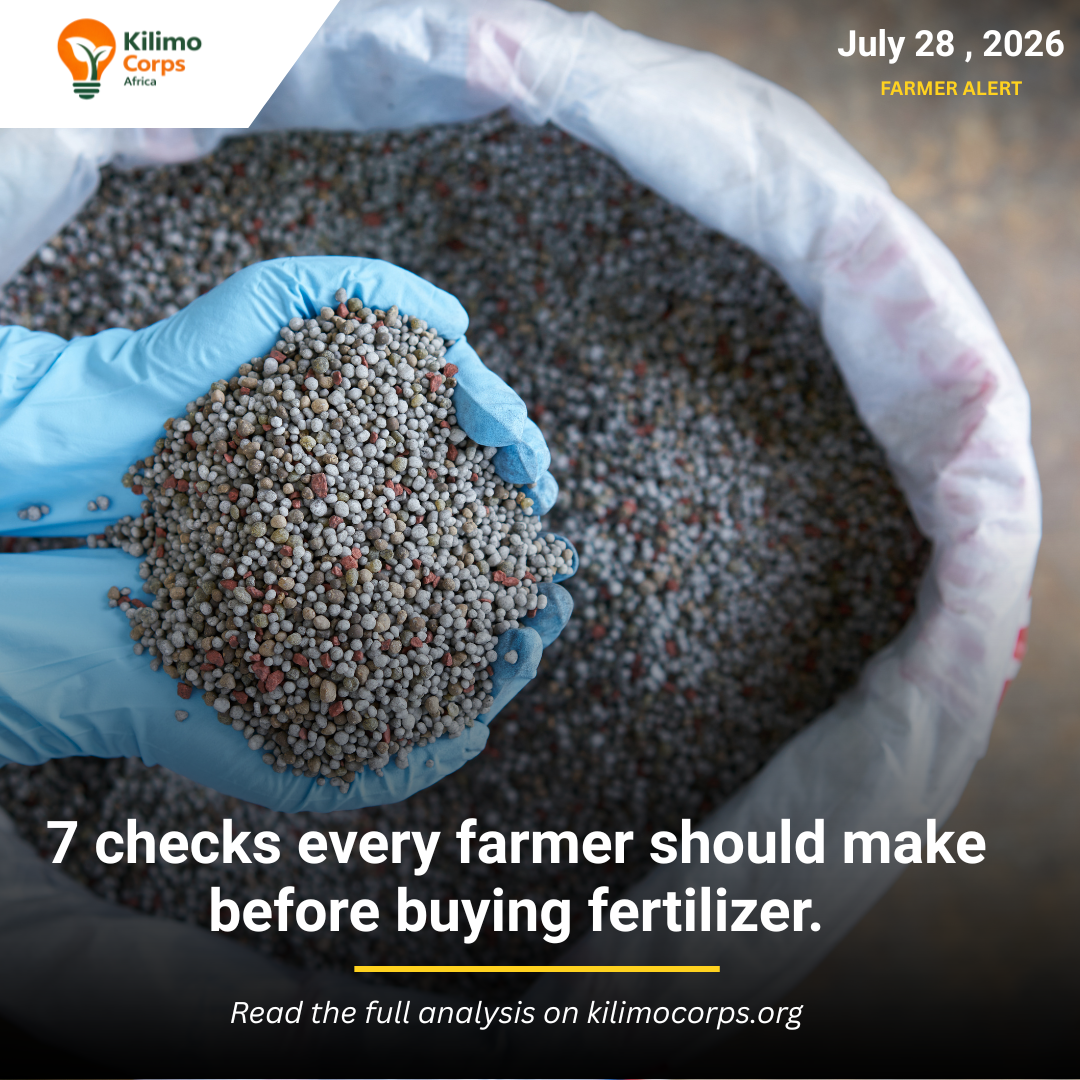
Seven Ways to Identify Genuine Fertilizer
- Buy only from licensed agro-dealers. Always purchase fertilizer from registered agro-input suppliers with established business premises. Licensed dealers are more likely to source products through authorised distribution channels. Avoid roadside vendors or temporary sellers operating from vehicles or informal stalls.
- Inspect the packaging carefully. Genuine fertilizer bags are professionally printed. Look for clear manufacturer details, batch numbers, product name, nutrient composition, weight and manufacturing information. Poor-quality printing, spelling mistakes or damaged seals should raise concern.
- Compare prices carefully. If one supplier offers fertilizer significantly below prevailing market prices, ask why. Large price differences deserve further investigation. Quality agricultural inputs rarely sell at unrealistic discounts.
- Request an official receipt. A receipt provides evidence of purchase should concerns arise later. It also demonstrates that the supplier is operating through legitimate business processes. Never leave a supplier without proof of purchase.
- Verify the supplier. Before purchasing large quantities, ask whether the supplier is authorised, check business registration where possible, confirm contact information and seek recommendations from local extension officers. Reputation matters.
- Examine the product. Where packaging allows inspection, watch for excess moisture, unusual odours, foreign materials, excessive dust, irregular granule size and colour inconsistencies where applicable. Although appearance alone cannot confirm authenticity, unusual characteristics deserve caution.
- Consult agricultural extension officers. Extension officers remain valuable sources of practical advice. They can recommend suitable fertilizer formulations for specific crops and local soils while helping farmers identify suspicious products.
Common Fertilizer Scams
Farmers should remain alert to several common fraud schemes.
- Repackaging: used fertilizer bags are filled with inferior materials before resale.
- False branding: products imitate well-known manufacturers using similar colours and logos.
- Expired products: expired fertilizer is relabelled and sold as new stock.
- Bulk mixing: low-quality materials are mixed with genuine fertilizer to increase volume.
- Online fraud: fraudsters advertise fertilizer online at unrealistic prices before requesting advance payments.
Before You Buy: Practical Farmer Checklist
- Buy from licensed agro-dealers.
- Compare prices.
- Check packaging.
- Inspect seals.
- Request receipts.
- Record batch numbers.
- Keep empty bags after use.
- Report suspicious products immediately.
Red Flags
Be cautious if:
- The price is dramatically lower than elsewhere.
- Packaging appears poorly printed.
- The seller refuses to issue a receipt.
- Bags have been resealed.
- The seller pressures immediate payment.
- Products are sold from temporary roadside locations.
Common Mistakes Farmers Make
- Choosing the cheapest supplier.
- Purchasing without receipts.
- Ignoring damaged packaging.
- Buying from unknown online sellers.
- Failing to retain packaging after application.
- Not consulting extension officers.
What To Do If You Suspect Fake Fertilizer
If you suspect fertilizer may be counterfeit:
- Stop using the remaining product.
- Preserve the packaging.
- Keep the purchase receipt.
- Record batch numbers.
- Contact the supplier immediately.
- Report concerns to the relevant county agriculture office.
- Notify the Anti-Counterfeit Authority or other relevant regulatory agencies.
- Where applicable, seek guidance from the product manufacturer.
- Early reporting helps protect other farmers.
Why Farmer Education Matters
Regulation alone cannot eliminate counterfeit agricultural inputs.
An informed farmer remains the strongest line of defence.
Knowledge enables producers to ask better questions, verify products, recognise warning signs and make purchasing decisions based on evidence rather than price alone.
As agriculture becomes increasingly commercialised, input literacy should become as important as production knowledge.
Conclusion
Counterfeit fertilizer represents more than an isolated criminal activity.
It threatens productivity, enterprise development and national food security.
Every planting season begins with investment.
Protecting that investment starts before the fertilizer reaches the field.
It begins with informed purchasing decisions.
The most productive farms are not simply those using more fertilizer. They are those using the right fertilizer, purchased from trusted sources and applied appropriately.
Kilimo Corps Africa Perspective
Agriculture functions on confidence.
Farmers invest months of labour and significant financial resources long before they harvest a single crop. Every bag of fertilizer represents more than a commercial transaction—it represents hope, planning and the expectation of a productive season.
When counterfeit agricultural inputs enter the market, they undermine far more than individual harvests. They weaken trust between farmers and suppliers, discourage investment, distort fair competition and threaten national food security.
Protecting the integrity of agricultural inputs is therefore not solely the responsibility of regulators. It requires a coordinated effort involving manufacturers, agro-dealers, extension officers, researchers, policymakers and farmers themselves.
Farmer education remains one of the most effective forms of prevention. A producer who understands how to verify products, recognise warning signs and purchase responsibly is far less vulnerable to fraud than one relying on price or convenience alone.
Institutions also have a critical role. Strong certification systems, effective market surveillance, transparent enforcement and accessible reporting mechanisms help build confidence across agricultural value chains. Public trust grows when quality standards are consistently enforced and genuine businesses are protected from unfair competition.
At Kilimo Corps Africa, we believe that agricultural transformation begins with informed decision-making. Productivity depends not only on improved technologies, but also on the confidence that the tools and inputs farmers purchase are genuine, safe and fit for purpose.
Food security starts long before the first seed is planted. It starts with trust in the systems that support agriculture.